
Kaysarul Anas Apurba
CV M.Sc. Computational Sciences · Laurentian University
I am an independent ML researcher and PhD applicant with an M.Sc. in Computational Sciences from Laurentian University, Canada (CGPA 9.10/10). My work spans medical image analysis, NLP, and network security — with a focus on building systems that are both accurate and deployable in low-resource settings.
My research interests include LLM Security, Intrusion Detection, Adversarial Robustness, Information Retrieval, and Medical Image Analysis. I am currently working on RAG systems hardened against retrieval poisoning and prompt injection, and automated malaria cell segmentation from blood smear images.
I am actively engaged in several ongoing collaborative projects. For a closer look at my recent and current work, please visit my Research page.
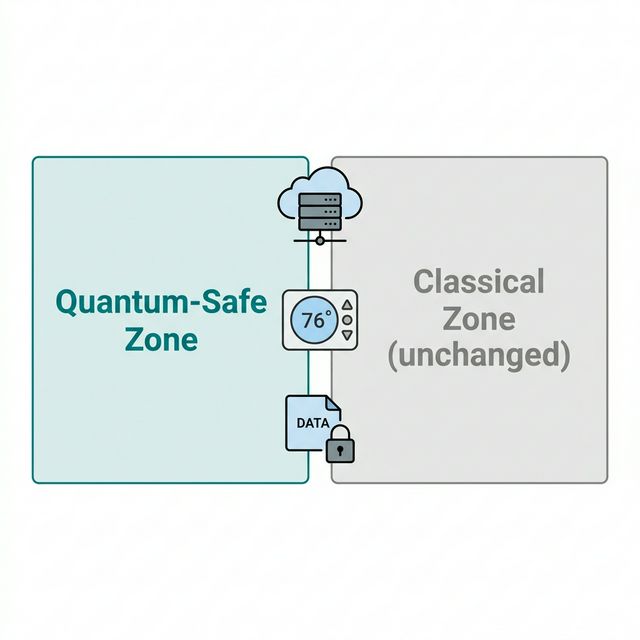
A Non-Invasive Cloud-Based Migration Strategy for Post-Quantum Cybersecurity in Smart HVAC Systems: Architecture, Implementation, and Empirical Evaluation
Symmetry (MDPI) Targeting Symmetry Preprint 2026
Legacy smart HVAC systems suffer from critical quantum vulnerabilities due to their reliance on classical ECDH. We propose a non-invasive, cloud-based proxy architecture that integrates NIST-standard post-quantum cryptography (ML-KEM and ML-DSA) into the ecosystem without modifying legacy hardware or firmware, providing a deployable migration pathway to quantum-safe security.
Legacy smart HVAC controllers rely on vendor-cloud TLS secured by ECDH and RSA, both broken by Shor's algorithm, and typical 10–15 year lifespans mean today's devices remain in service through the quantum-threat era. Direct on-device post-quantum cryptography is infeasible: an ESP32-S3, representative of capable HVAC hardware, has only 339 KB free heap against the 900 KB ML-KEM-768 requires, and even classical ECDH-P256 keygen (111.93 ms) dwarfs hardware AES-128 (0.032 ms). We propose a non-invasive PQC proxy, requiring no device, firmware, or vendor-cloud changes, performing ML-KEM-768 encapsulation and ML-DSA-65 authentication (NIST FIPS 203/204) with AES-256-GCM session keys via HKDF, implemented with Open Quantum Safe liboqs on a Raspberry Pi 4B gateway. Over 500 runs, the post-quantum handshake (Steps 1–6) completes in 2.48 ms, 0.38 ms slower than classical baseline, with PQC computation around 8% of handshake time at 20 ms simulated round-trip network latency. The gateway sustains 443 sessions/second, 100% success under 32 concurrent connections, extrapolating to 3,546 sessions/second on a 32-core cloud instance. Five side-channel tests, including verified in-place session-key zeroization and a fixed-vs-random TVLA timing analysis, found no exploitable timing leakage or susceptibility to man-in-the-middle attacks. The architecture is vendor-agnostic and becomes unnecessary once vendors adopt NIST PQC natively.
Defending Retrieval-Augmented Intrusion Detection Against Knowledge Poisoning and Prompt Injection
The 12th IEEE International Conference on Collaboration and Internet Computing (IEEE CIC 2026) Accepted Accepted 2026
Retrieval-Augmented Generation (RAG) enables large language models to classify network flows and generate human-readable incident reports by retrieving semantically similar historical traffic from a vector knowledge base. However, the retrieval layer introduces vulnerabilities to knowledge poisoning and prompt-injection attacks. We present RAG-IDS, a three-tier multi-agent intrusion detection framework with a retrieval-boundary defense combining soft trust scoring, label-embedding consistency checking (LECC), and prompt sanitization designed to recover classification quality under retrieval-layer attacks. Experiments on CIC-UNSW-NB15 show recovery relative to clean undefended performance ranging from R=1.0 at 1% poisoning to R=0.57 at 30%, with negligible clean-performance overhead. Under prompt injection, multi-document retrieval limits label-flip success to 0.6–2.4%, compared with 35–55% for single-document retrieval. Ablation results show that LECC is the primary contributor to robustness, while soft trust-based demotion outperforms hard filtering. The defended RAG pipeline offers an explainable, attack-resilient foundation for intrusion detection, well suited for hybrid deployment alongside high-throughput classifiers.
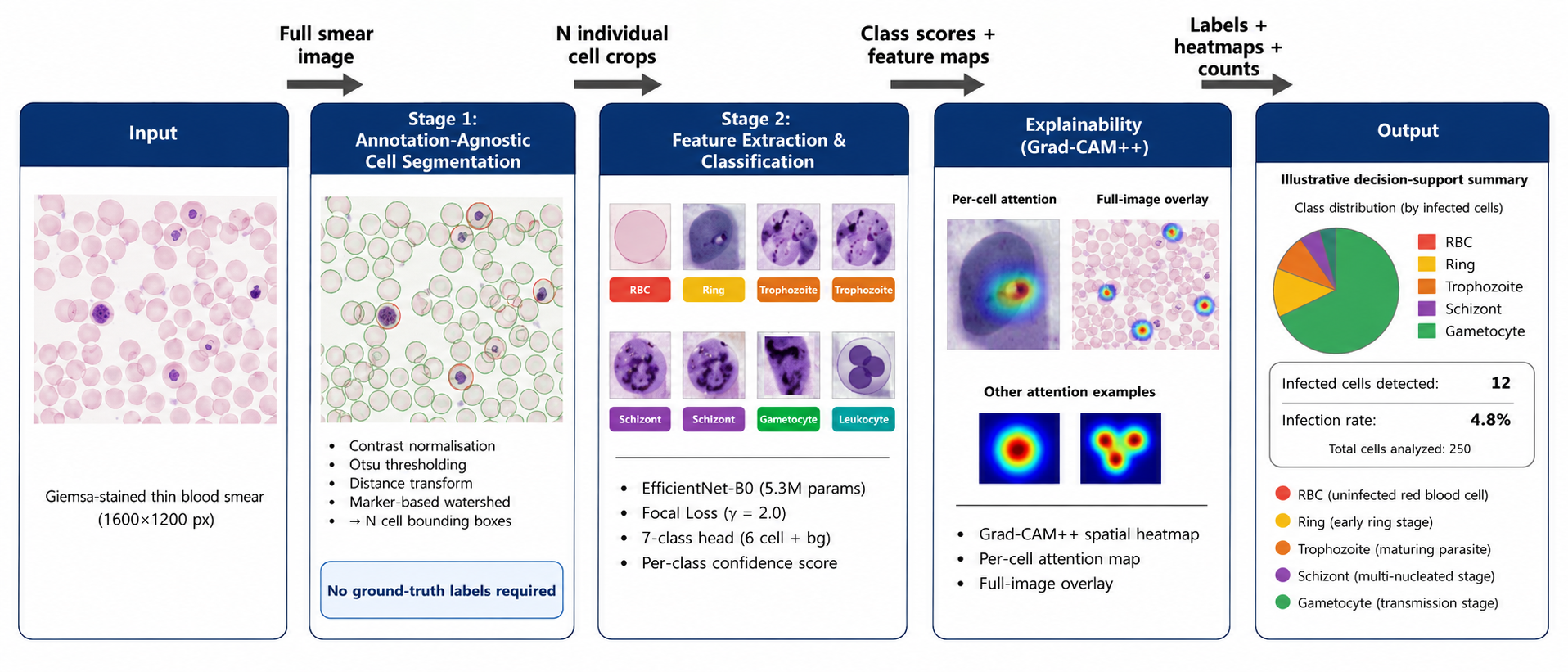
MalariAI: A Label-Resilient Decoupled Framework for Annotation-Agnostic Cell Segmentation and Explainable Stage Classification in Dense Malaria Blood Smears
Array (Elsevier) Submitted 2026
We present MalariAI, a two-stage decoupled framework for annotation-agnostic cell segmentation and explainable stage classification in dense malaria blood smears. Stage 1 applies distance-transform watershed to recover 75.95% of ground-truth cells without any annotation input; end-to-end binary parasitized AP@0.5 reaches 29.10% (multi-class mAP@0.5: 8.67%). Stage 2 fine-tunes EfficientNet-B0 with Focal Loss to 98.36% crop classification accuracy, with 87.5% and 75.0% on the rare schizont and gametocyte stages. Grad-CAM++ heatmaps provide per-cell spatial evidence for clinical audit, confirmed by energy-in-box analysis (+0.0485, paired p = 1.4×10⁻³³). Evaluated on NIH BBBC041 with zero-shot transfer to MP-IDB.
Accurate Prediction of Pulmonary Fibrosis Progression Using EfficientNet and Quantile Regression: A High Performing Approach
IEEE Region 10 Symposium (TENSYMP 2023) Conference 2023
Accurate prediction of pulmonary fibrosis progression is crucial for effective patient management. This study proposes an efficient deep learning framework for predicting the progression of pulmonary fibrosis using high-resolution computed tomography (HRCT) images. We leverage the EfficientNet architecture, known for its high accuracy and computational efficiency, to extract discriminative features from CT scans. To capture the uncertainty inherent in disease progression, we employ quantile regression instead of standard mean-based regression. This approach allows us to model the conditional distribution of future lung function, providing not only a point prediction but also prediction intervals that quantify the uncertainty associated with the prognosis. Our experiments on a benchmark dataset demonstrate that the proposed EfficientNet-based quantile regression model achieves state-of-the-art performance, outperforming existing methods in predicting pulmonary fibrosis progression while providing reliable uncertainty estimates.